Chatbot vs. AI voice agent: the differences
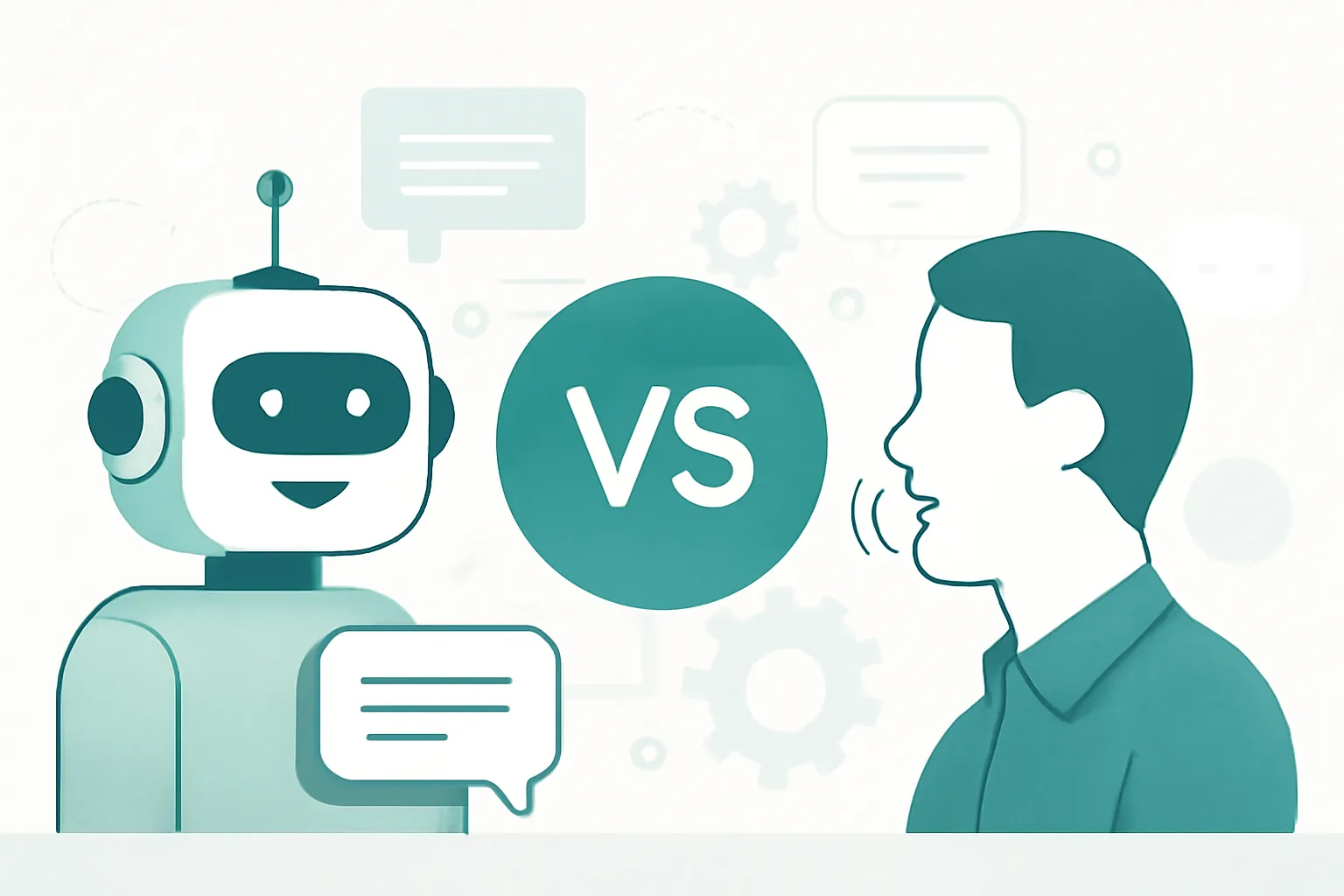
"Chatbot", "voice agent" and "AI assistant" are often used interchangeably. They are not the same thing, and mixing them up leads to buying the wrong tool.
The main difference is not in the technology but in the channel and the kind of conversation each one handles.
Chatbot: text, written channels
A chatbot converses in writing: WhatsApp, the website widget, Instagram.
Its advantage is that the user can reply whenever it suits them. A customer writes at 11:40 pm, the chatbot answers instantly and the conversation continues the next day without anything getting lost.
Where it works best: ecommerce (order status, returns, sizing), lead capture, and frequent questions with concrete answers.
Its limit: long or emotional conversations work poorly in writing. Someone with a serious issue does not want to type five messages — they want to talk.
Voice agent: phone calls
A voice agent answers or makes phone calls. It listens, understands and replies out loud, in real time.
It is technically more demanding than a chatbot: the voice has to be transcribed, understood, a reply generated and synthesised back into speech, all in under a second so the conversation does not feel awkward.
Where it works best: sectors where customers still pick up the phone. Clinics, restaurants, repair shops, professional services. Also outbound calls: confirming appointments, reminding customers about check-ups.
Its limit: the cost per conversation is higher than a chatbot's, and the margin for error is smaller. In text, an odd reply gets re-read; in voice, it kills the conversation.
AI assistant: the umbrella term
"AI assistant" does not refer to a specific channel. It usually means a system that combines several channels and executes actions in your systems: creating the appointment, changing the order, updating the CRM.
That is the difference that matters: a chatbot that only answers questions informs; an assistant with access to your calendar resolves. The second delivers far more value and also requires more integration.
Which one your business needs
The right question is not which one is better, but how your customers contact you right now.
Look at it with data, not intuition:
- If most contact comes in through WhatsApp → start with a chatbot.
- If the phone never stops and calls get missed → start with a voice agent.
- If both channels have volume → start with the one that generates more direct revenue, not the one with more volume.
That last nuance matters. Many businesses receive lots of informational queries on WhatsApp and few calls, but calls convert far better. Automating the highest-volume channel is not always the most profitable move.
Frequently asked questions
Can I have a chatbot and a voice agent at the same time?
Yes, and it is the usual setup when both channels have volume. What matters is that they share the same underlying information: if the chatbot says one thing and the voice agent another, customers notice.
Which one is cheaper?
The chatbot, almost always. Processing text costs less than processing voice in real time. But comparing on isolated cost is misleading: what matters is the cost per resolved conversation.
Do I need to integrate it with my CRM?
To answer questions, no. To execute actions — booking an appointment, checking an order — yes. That is the difference between informing and resolving.
Will they replace my team?
Set up properly, no. They absorb the repetitive work — opening hours, availability, order status — so your team spends its time on what requires judgement. When the goal is to replace people, the customer experience usually gets worse.
In short
Choose by channel, not by technology. And start with a concrete, measurable case before automating your entire customer service.
Not sure which one fits your business? Tell us your case and we will look at it together.
Kevin Rojas — Fundador de Veltim. Programador e ingeniero de IA: agentes de voz, chatbots de WhatsApp e integraciones con CRM para negocios reales. LinkedIn · YouTube · Sobre Veltim
Contact: veltim.com · Phone: +34 623 05 08 56 · Madrid, Spain.